

Future-proof cooling with natural refrigerants
Refrigerant selection directly affects system efficiency, environmental impact, operating costs, and long-term compliance. Natural refrigerants provide a proven alternative to synthetic refrigerants with high global warming potential.
GRADE is committed to advancing the use of natural refrigerants across industrial cooling and heating applications. We design refrigeration systems using ammonia (NH₃) and carbon dioxide (CO₂), combining proven technology with specialist engineering. Each solution is developed around the required temperature, capacity, operating conditions, and safety standards to deliver efficient, reliable, and sustainable performance throughout its lifecycle.

Built for efficiency and long-term performance
Natural refrigerants occur naturally in the environment and have very low or zero global warming potential. Their use reflects GRADE’s commitment to reducing environmental impact and supporting the transition towards more sustainable industrial cooling and heating.
Their strong thermodynamic properties can improve energy efficiency, reduce refrigerant consumption, and lower operating costs. Natural refrigerants also reduce dependence on synthetic refrigerants affected by environmental regulations and phasedown requirements.

Why natural refrigerants matters
Lower operating costs
High thermodynamic efficiency helps reduce energy consumption, control operating expenses, and improve total cost of ownership
Reliable system performance
Natural refrigerants deliver stable cooling under demanding conditions, helping protect product quality, process continuity, and daily operations
Low to zero global warming impact
Very low or zero global warming potential helps reduce emissions, support sustainability targets, and strengthen long-term environmental performance
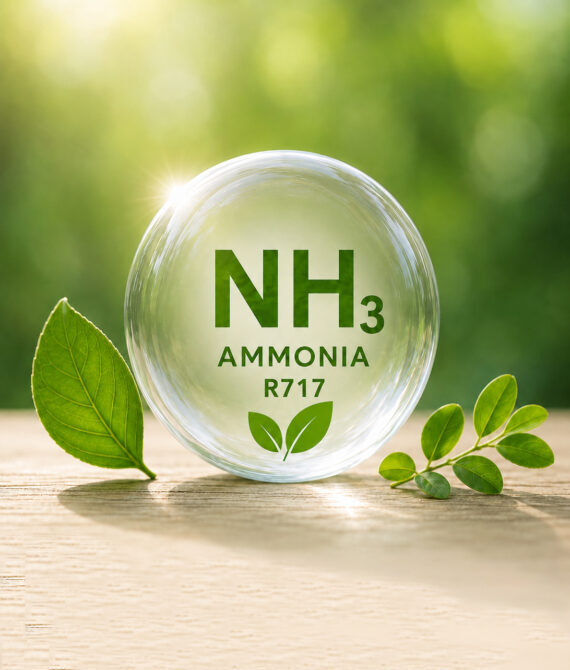
Ammonia for energy-efficient cooling
Ammonia, also known as R717, has zero global warming potential and zero ozone depletion potential. Its strong heat transfer properties make it ideal for large industrial refrigeration systems.
Ammonia delivers high cooling capacity with lower refrigerant flow rates. It is widely used in food processing, cold storage, logistics, ice production, and process cooling.
It also supports heat recovery and industrial heat pump applications, allowing rejected heat to be reused for hot water, cleaning, heating, or production processes.
Advantages of ammonia (R717)
- High energy efficiency
- Excellent heat transfer
- Zero GWP and zero ODP
- Reliable low-temperature performance
- Suitable for large-capacity systems
- Strong heat recovery potential

Compact cooling with carbon dioxide
Carbon dioxide, also known as R744, has a global warming potential of 1 and zero ozone depletion potential. It is non-flammable and performs well in low-temperature refrigeration applications.
Its high operating pressure allows the use of compact piping and components while delivering high cooling capacity. CO₂ systems can operate in transcritical, subcritical, or cascade configurations.
In cascade systems, CO₂ is often combined with ammonia. This provides efficient low-temperature cooling while reducing the ammonia charge in occupied or production areas.
Advantages of carbon dioxide (R744)
- GWP of 1 and zero ODP
- Non-flammable refrigerant
- Compact system design
- High volumetric cooling capacity
- Strong low-temperature performance
- Suitable for cascade and transcritical systems